
Stoichiometry Calculator
Type a chemical equation — the calculator balances it, shows the molar mass of each substance, and converts a given amount of any reactant into moles and grams of every other substance. Enter two reactant amounts to find the limiting reactant and theoretical yield.
- Free to use
- No sign-up
- Runs in your browser
Solve a stoichiometry problem
Stoichiometry Practice & Reference Pack
Step-by-step worksheet templates, a molar mass reference table and an Excel stoichiometry solver for homework checking.
- Mole-ratio solver (XLSX, PDF)
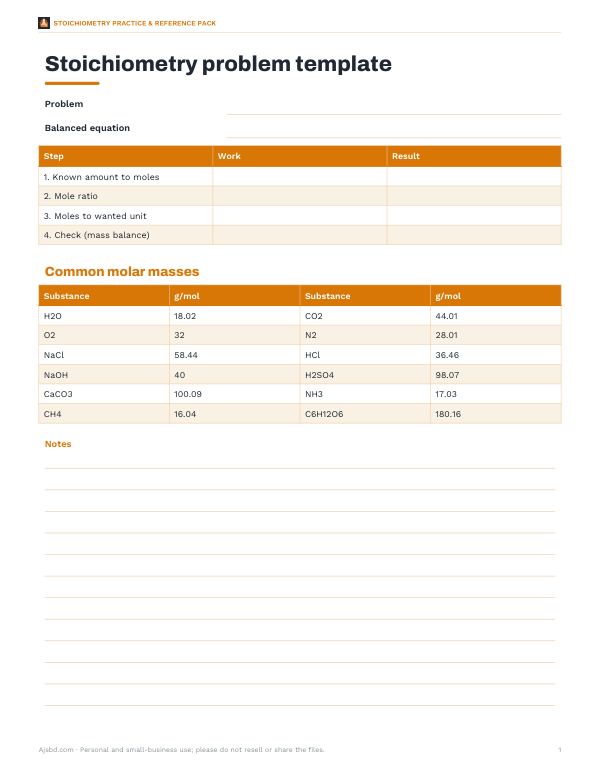
- Worksheet templates & molar mass table (PDF, DOCX)
Formats: XLSX, PDF, DOCX. Instant download after payment (link valid 72 hours, up to 5 downloads). AI-assisted: the templates were drafted with AI help and reviewed and laid out before publishing.
$4.00 USD, one-time
- Instant download
- 7-day refund
- Secure checkout by Stripe
7-day money-back guarantee. Full refund within 7 days of purchase, even after you download.
Full refund within 7 days — see the refund policy and license.
Free printables
Single sheets you can print right now, no sign-up. The full pack adds every sheet in one download plus the editable files.
What stoichiometry is
Stoichiometry is the arithmetic of chemical reactions: using a balanced equation to work out how much of each substance reacts or forms. A balanced equation tells you the ratio of moles, not grams, so every stoichiometry problem follows the same path — convert what you know into moles, use the mole ratio from the coefficients, then convert back into whatever unit the question asks for.
The four steps
- Balance the equation so each element has the same number of atoms on both sides.
- Convert the known amount to moles: moles = mass ÷ molar mass.
- Use the mole ratio: moles wanted = moles known × (coefficient wanted ÷ coefficient known).
- Convert to the unit you need: mass = moles × molar mass.
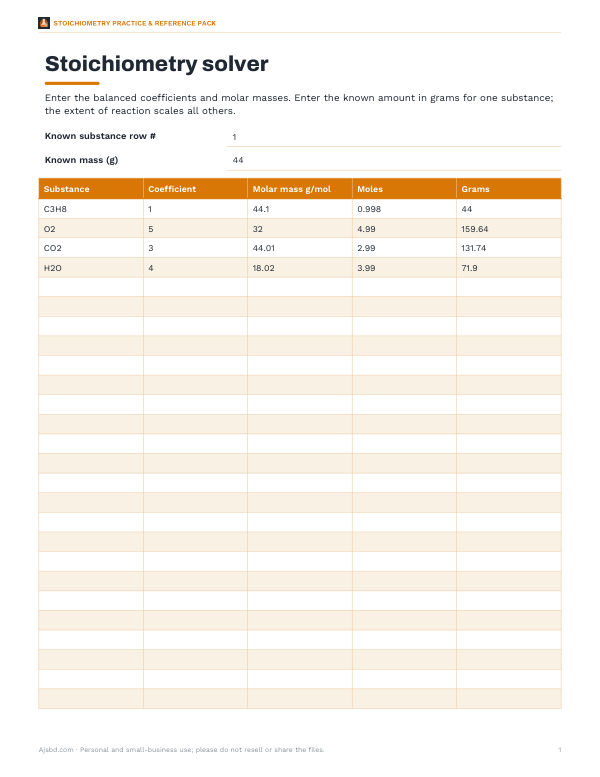
The calculator shows the balanced equation, each molar mass and a table of moles and grams for every substance, so you can check each step of your own working. It uses the “extent of reaction” — moles of the known substance divided by its coefficient — which makes it easy to scale every other substance at once.
How the equation balancer works
Balancing an equation is a set of simultaneous equations: for every element, the atoms on the left must equal the atoms on the right. The calculator writes one equation per element, solves them exactly with fractions, and scales the result to the smallest whole-number coefficients. Formulas can include parentheses and square brackets, such as Ca(OH)2 or Al2(SO4)3, and hydrates written with a dot, such as CuSO4·5H2O or CuSO4.5H2O. Element symbols must use a capital first letter and a lowercase second letter, because Co (cobalt) and CO (carbon monoxide) are different.
Worked example: burning propane
Propane burns in oxygen: C₃H₈ + O₂ → CO₂ + H₂O. Balanced, it is C₃H₈ + 5 O₂ → 3 CO₂ + 4 H₂O. The molar mass of propane is 3 × 12.011 + 8 × 1.008 = 44.097 g/mol, so 44 g of propane is 0.998 mol. The mole ratios give 4.99 mol of O₂ (159.6 g), 2.99 mol of CO₂ (131.7 g) and 3.99 mol of H₂O (71.9 g). The masses of reactants (44 + 159.6 = 203.6 g) equal the masses of products (131.7 + 71.9 = 203.6 g), as conservation of mass requires.
Limiting reactant and theoretical yield
When amounts of two reactants are given, one usually runs out first. That limiting reactant decides how much product can form; the other reactant is left in excess. To find it, divide the moles of each reactant by its coefficient: the smaller result is the limiting one. Choose a second reactant in the calculator and enter its mass to see the limiting reactant, the theoretical yield of each product and how much of the excess reactant remains.
Theoretical yield is the maximum product from complete reaction of the limiting reactant. The amount actually obtained in a lab is usually less; comparing the two gives the percent yield.
Common mistakes to avoid
- Using an unbalanced equation — every ratio will be wrong.
- Using the mass ratio instead of the mole ratio.
- Forgetting that diatomic elements are written O₂, H₂, N₂, Cl₂, F₂, Br₂ and I₂.
- Mixing up subscripts (part of the formula) and coefficients (how many molecules).
- Rounding molar masses too early; keep extra digits until the final answer.
- Choosing the reactant with the smaller mass as limiting — it depends on moles and coefficients, not grams.
Molar masses used
Molar masses are calculated from IUPAC standard atomic weights (abridged), such as H 1.008, C 12.011, N 14.007, O 15.999, Na 22.990, Cl 35.45. Your textbook may round slightly differently — for example C = 12.01 or Cl = 35.5 — which changes answers in the third or fourth significant figure. Report your final answer with the number of significant figures your data supports.
Beyond grams: gases and solutions
The same mole ratios apply when amounts are given as gas volumes or solution concentrations; only the conversion to moles changes. For an ideal gas at standard temperature and pressure (0 °C and 1 atm), one mole occupies about 22.4 litres, so 11.2 L of oxygen is 0.5 mol. At other conditions use PV = nRT. For solutions, moles = molarity × volume in litres: 250 mL of 0.40 M hydrochloric acid contains 0.10 mol of HCl. Convert to moles first, then use the calculator's mole option to get every other quantity.
Checking your answer
Two quick checks catch most errors. First, conservation of mass: the total mass of reactants consumed should equal the total mass of products formed, which the table makes easy to compare. Second, sense of scale: if a few grams of reactant appear to make kilograms of product, a unit or ratio has gone wrong. When results look odd, recheck the formulas for typing mistakes — a missing subscript is the most common cause.
Frequently asked questions
Can this calculator balance equations?
Yes. It balances equations with a single independent solution and shows the smallest whole-number coefficients.
How do I write parentheses and hydrates?
Type them as written, e.g. Ca(OH)2, Al2(SO4)3, CuSO4·5H2O or CuSO4.5H2O.
What is the limiting reactant?
The reactant that runs out first. It is found by comparing moles divided by coefficients.
Why is my answer slightly different from the textbook?
Textbooks often round atomic weights. Differences in the third or fourth significant figure are normal.
Can I enter moles instead of grams?
Yes, choose “moles” as the unit for the known substance.
Does it handle ionic equations?
Charges are not supported; write the neutral compounds or balance the net ionic equation by hand.
Can I use it for gas volume problems?
Convert the gas volume to moles first (22.4 L per mole at STP, or PV = nRT), then enter moles.